
Family & Education
Work, Migration, & Policy Implications

Work, Migration, and Policy Implications
A Singapore Research Nexus Policy Outreach Event
This event spotlights NUS FASS academics' research and insights on work, migration, and policy implications in Singapore.
Speakers
Allen XIAO | Assistant Professor, NUS Department of Geography
Nur Amali IBRAHIM | Associate Professor, NUS Department of Sociology and Anthropology
Zheng MU | Assistant Professor, NUS Department of Sociology and Anthropology
Download the programme here.
Presentation Abstracts and Biographical Statements of Speakers
Planning Africa’s Singapore: Geographical Imagination and Practices
As an aspirational target, Singapore as model provides a sense of the possible for the development of Rwanda, a landlocked small country in East Africa. Yet how are those possibilities transformed into plans? This paper draws on a close reading of the Kigali Master Plan 2050, authored by a Singaporean urban planning firm, and interviews with stakeholders in Rwanda’s public and private sectors to understand how the plan is put to work in the aspect of building a smart city, linking future-looking and future-making. We find that the Master Plan imagines Rwanda-Kigali as a national-urban nexus, echoing without duplicating Singapore’s distinctive model. Making the Master Plan for the capital city Kigali and transforming Kigali into a smart city demonstrate the strong nexus of national and urban institutions in which the urban is endowed with symbolic power and coordinated centralization at the level of City of Kigali has been widely advocated. Thus, the key to make Rwanda Africa’s Singapore is to institutionalize Kigali’s urban futures.
Assistant Professor Allen XIAO | NUS Department of Geography
Allen Xiao is an urban and cultural geographer who has been doing ethnographic research on urban lives in Lagos, Nigeria—the largest metropolis in Sub-Saharan Africa—as well as on African diasporic lives in Asia. Drawing from human geography, cultural anthropology, African studies, and urban studies, his research interests broadly involve how urban subjectivity is shaped at the nexus of identification processes, mobility experiences, and transnational and regional linkages. Currently, he is developing his research on urbanism that bridges Southeast Asia and Africa.
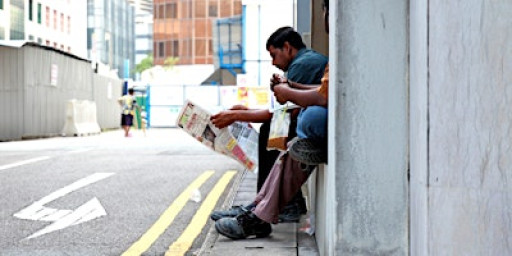
Complaint: Migrant Workers, Wage Theft, and the Possibilities of Care
Based on ethnographic research with low wage migrant workers in Singapore, this paper examines complaint as a method of seeking restitution for wage theft. I will argue that complaint can provide some redress but typically not justice, suggesting therefore that it is a care that is tangled up with exploitation in complicated ways. To make this argument, I describe how migrant workers seek assistance from civil society activists to file their complaints with the Ministry of Manpower, which involves multiple stages from reportage to investigation, fact-finding, and dispute resolution. Such workers will typically face pressure from state bureaucracy to drop the case over the multiple stages of the complaint process. In the event that a worker persists in his pursuit of the complaint, it is unlikely that he will receive the full repayment of monies owed to him. Despite its shortcomings, complaint generates side effects that may not necessarily resolve the worker’s problems but can matter greatly in other ways. One example is when the worker, through the act of complaining or by helping others to complain, gains crucial political knowledge regarding the labor system in which they exist. These side effects should lead us to consider other forms of care that can exist alongside the deeply imperfect system of state care.
Associate Professor Nur Amali IBRAHIM | NUS Department of Sociology and Anthropology
Nur Amali Ibrahim is a sociocultural anthropologist who conducts research on the state and civil society in Southeast Asia. Thematically, he is interested in the transformations of governance in a contemporary world characterized by multiple interlocking processes especially late capitalism, religious revitalization, the rise of social movements, the hardening of borders, and climate change. He received a BA (first class hons) in Southeast Asian Studies from the National University of Singapore, and an MA and PhD in Anthropology from New York University. Prior to joining the Department of Sociology and Anthropology at the National University of Singapore, he was a postdoctoral fellow at the Harvard Academy for International and Area Studies at Harvard University, and held faculty positions in the Departments of Religious Studies and International Studies at Indiana University, and the Division of Social Sciences (Anthropology major) at Yale-NUS College. His research has been supported by the National Science Foundation, the Social Science Research Council, and the Wenner-Gren Foundation, as well as numerous intramural grants.
Opting For the Optionless: Comparing Stay-at-home Motherhood Among College-educated Chinese Women in Shanghai, Singapore, and New York
College-educated stay-at-home mothers are caught in a dilemma between their opting-out identity as skilled labourers and opting-into caregiving obligations. Their experiences vary by context when migration engages in their decision-making process. Drawing upon in-depth interviews with 90 Chinese college-educated stay-at-home mothers residing in three major global cities—Shanghai, New York, and Singapore—this research arrives at a comparative, multi-layered analysis of how gender conventions intersect with autonomy and lead to their ad-hoc empowerment. We found commonalities across geographies determining women’s career compromise in accordance with the gender division of labour when intergenerational support is insufficient, and parental companionship contributes to children’s development. On the other hand, these stay-at-home mothers demonstrate divergent decisions on returning to the workplace across different contexts in terms of the difficulties and necessities of shifting their identity, forming three types: freedom-under-neglect mothers in Shanghai, excusable homemakers in New York, and mothers accused of self-responsive failure in Singapore. While some women express their sense of empowerment as stay-at-home mothers, others feel pressured to opt for professional development. However, what underlies the dichotomous experiences is a consistent priority of family interests over women’s individual aspirations, and ad-hoc empowerment conditioned on how successfully mothers navigate the private-public sphere by fulfilling temporal family goals that change across geographical localities during migratory stages.
Assistant Professor Zheng MU | NUS Department of Sociology and Anthropology
Dr Zheng Mu’s general research interests focus on trends, social determinants, and consequences of marriage and family behaviours, with a focus on how marriage and family have served as inequality-generating mechanisms. Her ongoing research projects examine how internal migration, ethnic identification, interactions between gender and intergenerational inequality, and interactions between ideational and socioeconomic contexts shape individuals’ time use patterns, family experiences, and well-being in China and Singapore.
Registration
In-person: https://Work_Migration_Policy.eventbrite.sg
Zoom: https://nus-sg.zoom.us/meeting/register/bxZJf1cET26cKmmMSs3Dxw
Note: This event is aimed at academics and those working in policymaking. Please fill out all fields to register: 1. Name; Email; 2. Job title; 3. Company/Organisation. If you do not fill out all four fields when registering, your ticket may be cancelled.
Directions: To get to the Research Division Seminar Room, go to Level 6 of the AS7 Shaw Foundation Building and turn right after exiting the lift, going around the corridor past the washrooms. Turn left and you will see the Research Division Seminar Room directly ahead.