
Community & Culture
The Morphology of Modern Manchester

In Britain, during the post-war period, many urban design professionals were architect-planners. A considerable proportion of these were employed by local authorities. A drive by the state to use legislation to control and influence the shape of development created a very specific set of political circumstances. Central government policy was filtered and interpreted by local government councillors and their officers and each town or city approached this in a different way. The legislation and the training enabled a very particular mode of urban design that was characterised by ambitious three-dimensional visions. Such ambition was also underpinned by non-statutory guidance that reflected the zeitgeist for vertical separation in urban settings, such as Sir Colin Buchanan’s Traffic in Towns.
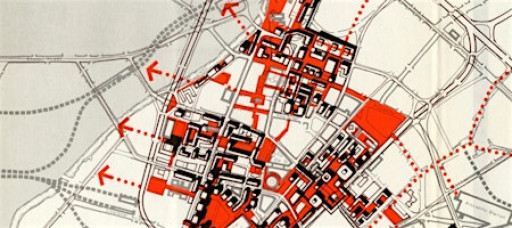
In this talk, Richard Brook will examine Manchester as a case, through which to explore the nested tiers and networked relationships of government, governance and the private sector in the creation of new city space. Manchester’s 1945 Plan, directed by City Engineer and Surveyor, Rowland Nicholas, was one of the most comprehensive in Britain, yet it faltered due to a lack of capital, lack of statutory powers and lack of material resources. In the 1960s, Manchester’s first Chief Planner, John Millar, revisited the urban design of the entire central area with a team of talented young planners, recruited from the region. Their work was arguably greater in its scope and definition than that produced in 1945 and shaped the city for the next 50 years. Though only partially realised, the framework for development established in the mid-1960s and approved in 1968, set the tone for almost all the changes to follow for the next 50 years.
Now, as the palimpsestic traces of earlier visions are increasingly obscured by the pace of contemporary urbanisation, using rich visual material collected over the last three decades of research, Richard will position architectural histories alongside planning and urban histories. He will show how central government legislation was interpreted spatially by Manchester’s planners using drawings and models and how these visions continued to inform development well into the twenty-first century. In so doing, he will present an inverted archaeology of the city that traces the patterns established on paper and the long-term physical residue of these gestures.
Who Should Attend?
This talk is for anyone who cares about how Manchester came to look and work the way it does, curious residents, city enthusiasts, students, and professionals alike. You’ll enjoy it if you walk, cycle, drive or shop in the city centre and want to understand why streets, routes and buildings are arranged as they are. Community group members, councillors and people in planning, architecture, transport, heritage or development will get clear, visually rich insights into how past decisions still shape today’s city. No prior knowledge needed, just an interest in Manchester’s story and a desire to see familiar places with fresh eyes.
Practical Information
The talk includes a Q&A session.
Booking is essential. Lit&Phil members: we recommend logging into the website to make booking your free member ticket quicker and easier.
Accessibility Information
The venue is wheelchair accessible with an accessible toilet on the ground floor. Please contact us regarding any specific accessibility requirements you may have by emailing events@manlitphil.ac.uk