
Performing & Visual Arts
Researching Relevance - Disability’s movement to mainstream

Disability In British Art (DIBA) was set up in 2022 to become a nexus for disability-focused arts research. A theme that kept recurring was the Disability Arts Movement (DAM) – a much misunderstood though highly influential and inspirational DIY movement within arts-focused disabled communities. This paper attempts to uncover DAM’s legacy, its definition of “Disability Art” and its influences on how the art of disabled artists is understood. A core question is posed regarding the treatment of disabled people during the Covid-19 Pandemic and how that would have been different had DAM not happened.
Focusing on disability as a much ignored aspect of the human condition, the paper discusses activism, art and the bloody mindedness that goes with changemaking and which influenced attitudes towards disabled artists during the Covid-19 pandemic. This is an important point of inquiry in our current era as it shows the gaps in our understanding of the value of human creativity beyond the needs of the gallery.
The contributions of the many academics and artists to DIBA will be considered, and how artists are redefining the concept of “disability art” will be discussed. This attitudinal shift is observed through the experiences of younger disabled artists as they push the envelope of disability art. The paper concludes with the intersectional gaps in knowledge yet to be addressed and the lack of presence of disabled artists from minority backgrounds.
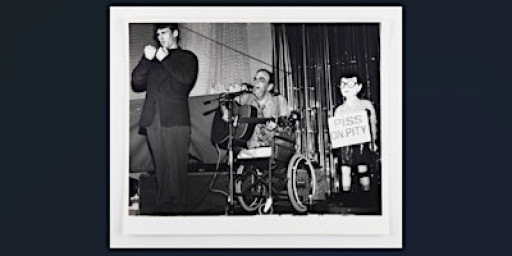
Image caption: Ian Stanton performing next to the Piss on Pity sign hung from the neck of "Chip the Crip," an old-style Spastics Society collecting box, 1990s. Image courtesy of the estate of Ian Stanton / National Disability Arts Collection and Archive (NDACA)
Accessibility at a Glance at the Paul Mellon Centre
✔ Hearing loop available (please contact events@paul-mellon-centre.ac.uk)
✔ Level access to exhibition space. A portable ramp can be deployed to enable wheelchair access. Ring the bell on the right-hand railings outside the main door at number 16 if required. Please contact events@paul-mellon-centre.ac.uk if ramp is needed.
✔ Accessible toilet on the ground floor.
Code of Conduct
This code is designed to create a positive and welcoming environment at the Paul Mellon Centre for Studies in British Art. It applies to all events, meetings and visits, in-person and online. It also extends to the social medial and digital platforms we use for events and communication.
These are our guiding principles:
Onsite: Individuals whose behaviour breaches this code will be asked to leave the building. The events manager or appointed host for the event or visit will take responsibility for making this decision.
Online: Abusive content posted online will be reported and removed.
Breaches of this code may result in the individual being blocked or barred from attending the Centre or participating in its activities, on site or online, in the future.
Any behaviour that breaches this code should be reported to a member of staff at an event or can be emailed to feedback@paul-mellon-centre.ac.uk
Our Code of Conduct is supported by the Centre’s Public Complaints Policy and Procedure.