
Film, Media & Entertainment
MOVING PAINTINGS—WITH SOUND: Early Short Films of DAVID LYNCH + ERASERHEAD

This January, 7th House, The Philosophical Research Society and Zebulon honor one of the great all time masters of cinema with their series NIGHT BLOOMING JASMINE: A CELEBRATION OF DAVID LYNCH, with events throughout the month at both PRS and Zebulon. Perhaps no artist has ever imbued their work with such darkness, mystery, wonder, beauty, and humor, a consummate creator whose journeys into the far reaches of imagination and consciousness have left an indelible and eternal mark on the world. For this very special program at The Philosophical Research Society, 7th House will explore his earliest experiments in cinema, beginning with his first short films SIX MEN GETTING SICK (SIX TIMES) (1967), THE ALPHABET (1968), THE GRANDMOTHER (1970), and THE AMPUTEE (Versions 1 & 2) (1974) and culminating with a screening of his visionary feature debut masterpiece ERASERHEAD (1977).
Since his Midwestern boyhood, David Lynch’s greatest aspiration was to be a painter, to immerse himself in what he referred to as “the art life.” Unlike many of his filmmaking contemporaries, Lynch did not grow up at the movies. Cinema was not a lifelong passion nor a career ambition. It wasn’t until the mid-1960s, while studying painting at Pennsylvania Academy of the Fine Arts (PAFA), that a single, uncanny experience quietly redirected his path. As Lynch later recalled, he was working on a painting of a dark, wooded landscape when he suddenly felt the image begin to move — the trees seeming to sway, accompanied by the sensation of wind and sound. The canvas no longer felt static, but alive.
In that moment, Lynch glimpsed the possibility of what he would later call “moving paintings—but with sound,” an intuitive revelation that became the true origin of his cinema, rooted less in narrative tradition than in pre-verbal sensory permutations and impenetrable mysteries. He soon shifted the focus of his studies to cinema, creating his first two short film experiments, SIX MEN GETTING SICK (SIX TIMES) – which integrated his paintings with mixed-media animation, and THE ALPHABET, before fully committing himself by moving to Los Angeles to attend the American Film Institute, where he made his remaining short films (the nightmarish and impressively ambitious THE GRANDMOTHER and THE AMPUTEE, x 2) and monumental, paradigm-shifting debut feature ERASERHEAD, the primal scene of midnight cinema.
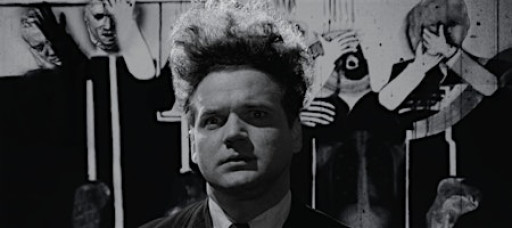
A masterfully unnerving vision of industrial alienation, the film follows Henry (Jack Nance), a timid man adrift in a decaying urban landscape as he confronts domestic anxiety, sexual dread, and the terror of unwanted parenthood – as personified by an unforgettable, not-quite-human baby. Uncontainable fertility is both a trait of the film itself and a theme. At the time of its making, Lynch was becoming a father for the first time; the film wriggles with cosmic spermatozoa and compels a sickening dread of deformity and failure to thrive.
Rendered in a stark black-and-white cloud of film grain and dominated by Lynch and sound designer Alan Splet’s mechanical drones and rumbles, ERASERHEAD is the apotheosis of Lynch’s moving painting passions, where dream dyslogic reigns over narrative causality — replete with man-made chickens and radiator-dwelling women.
Join us for a rare opportunity to trace Lynch’s cinematic origin story on the big screen, a chance to experience — in a single evening — the arc of one of film's most incomparable artists.
PRESENTED WITH INTERMISSION
Dir. David Lynch
Shorts Program: 1967-1974, 52 mins, United States, English, Unrated, Digital.
ERASERHEAD, 1977, 89 mins, United States, English, Unrated, Digital.
Special thanks to Janus Films.
Please email events@prs.org or phone 323-663-2167 with any questions.
ADVISORY DISCLAIMER
With some exception, The Philosophical Research Society’s 7th House Screenings does not typically provide advisory warnings about potentially upsetting content or subject matter, as sensitivities are particular to each viewer. Please be sure to read event listings, research on the web, or visit Common Sense Media, IMDb, and DoesTheDogDie.com for thorough info on content and age-appropriateness. If you have any specific content advisory questions, please email events@prs.org.
CONTENT DISCLAIMER
The views, opinions, and thoughts expressed within exhibited works are solely those of their creators and may not represent those of the Philosophical Research Society (PRS), its affiliates, or any individuals associated with PRS. Screenings are intended for educational and entertainment purposes.
ACCESSIBILITY
PRS wants all guests to be able to enjoy our events safely and comfortably. If you require any accessibility accommodation, please reach out to events@prs.org before showtime and we will be happy to assist you.
REFUND POLICIES
All sales are final. There are no refunds for PRS events , except in the event of a medical emergency, including but not limited to a positive COVID-19 test. Ticket exchanges may be granted on a case by case basis, pending circumstances.
In the event that PRS is forced to cancel an event entirely, tickets will be refunded or vouchers offered for a rescheduled event.
PARKING
We encourage attendees to consider carpooling, walking or biking to events if possible, and please be considerate of our Los Feliz neighbors when parking. Nearby street parking is available, as well as limited parking onsite at PRS in the front lot (entry from Los Feliz Blvd. when heading east).
PRS EVENT POLICIES