
Webinars
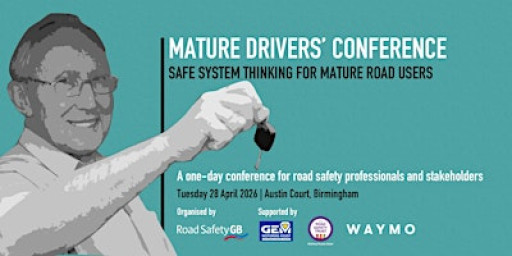
Mature Drivers' Conference: Safe System Thinking for Mature Road Users

The UK’s population is ageing, with the proportion of people aged 65 and over increasing year-on-year. As a result, the number of mature drivers is also on the rise. Government data shows there were more than 6 million people aged 70 or over with a full driving licence in the UK as of September 2024.
This conference - hosted by Road Safety GB and supported by GEM Motoring Assist, The Road Safety Trust & Waymo - will bring together road safety professionals and those committed to supporting mature drivers to maintain their independence while at the same time enhancing their safety.
Confirmed speakers and topics include:
OPENING KEYNOTE
Navigating the Road Ahead: Five Patterns of Adjustment in Older Adults Who Stop Driving
Professor Charles Musselwhite, FAcSS, Head of Psychology, Centre for Transport and Mobility, Aberystwyth University
Driving cessation is a major life transition for many older adults, with real impacts on independence, confidence, identity and day-to-day participation. While we know a lot about the risks associated with stopping driving, much less attention has been given to the fact that older adults don’t experience this transition in the same way. A structured thematic analysis of existing research in these papers identified five recurring coping profiles: Proactive Adapters, Reluctant but Responsible, Identity-Threatened Resisters, Socially Supported Dependents, and Constrained Survivors. Each segment shows distinct demographic patterns, coping strategies and risks. Proactive Adapters and Supported Dependents demonstrate the most positive outcomes, whereas Identity-Threatened Resisters and Constrained Survivors experience the greatest psychological and social burden. Understanding these segments helps practitioners tailor their approach. The review highlights practical strategies including identity-sensitive conversations, early planning, mobility and travel training, strengthening family and community support networks, and improving access to community transport—especially in rural and low-resource areas. Segment-specific interventions are proposed, including roles for community transport, health professionals, family and friends, occupational therapists and driver assessment and training centres. Overall, the work shows that driving cessation is not a single event but a varied and personal journey. Matching support to the type of older adult can improve wellbeing, reduce conflict and help people stay mobile and connected after they stop driving.
Mature & Older Drivers: The Real Statistics Behind Road Safety
Rob Heard MBE, Road Safety and Older Drivers Consultant
This session explores the reality of the UK’s growing mature and older driver population and what current collision data tells us. It will highlight national trends in licence ownership among over-70s, analyse key statistics on collisions involving older drivers, and examine common causes and high-risk scenarios. The talk will also outline licence renewal requirements at age 70 and beyond, including self-certification and potential issues linked to medical fitness to drive. This session aims to provide an evidence-based picture of older driver safety and provoke informed discussion on how best to support safe mobility in later life.
The effect of increasing older driver numbers on road casualties
Brian ``Lawton, Road Safety Research and Policy Officer, Road Safety Foundation
Britain’s aging population is resulting in more older drivers using our roads; while the human body becomes more fragile as we age, gaining driving experience often makes us more aware of - and better at – managing our own limitations. Some junction types and manoeuvres appear to pose a particular challenge for older drivers; the implications of some relatively common characteristics of crashes involving older drivers, and what can subsequently be done to improve older driver safety, will be discussed. In this presentation, the combined effects of these factors on long-term casualty numbers will be considered.
Empowering Safe Mobility: Driving Mobility’s Strategic Role in Supporting Mature Drivers
Dr Anu VARSHNEY, Strategic Director – Research, Education & Innovation for Driving Mobility & Head of Service, South East DriveAbility (SED), Kent Community Health NHS Foundation Trust
As demographic shifts continue to increase the proportion of older drivers on UK roads, ensuring safe, independent mobility for mature/senior drivers is both a public health imperative and a social equity challenge. The ability to drive represents autonomy, connection, and quality of life for many older adults. However, age-related changes in physical, cognitive, and sensory functions can increase road risk and challenge confidence behind the wheel. Driving Mobility, the national charity coordinating 20+ accredited driving assessment centres across the UK, provides a clinical and person-centred response to these challenges — helping older drivers remain safe, independent, and mobile for as long as possible. This presentation will explore how Driving Mobility’s national network supports mature drivers.
A partnership approach to engaging with mature drivers across West Mercia
Anna Southall & Vicki Bristow, Engagement & Campaigns Managers, West Mercia Police (both)
Across Worcestershire, Herefordshire and Shropshire, West Mercia Police Road Safety Team has engaged with hundreds of mature drivers over the last two years, using multi-agency awareness sessions, virtual reality technology, free webinars and subsidised refresher training. Anna and Vicki from the Road Safety Team will present their partnership approach, evaluation results and areas for further development in the future.
Supporting safe mobility for an ageing population: Evidence-based approaches to enhancing older driver safety
Dr Elizabeth Box, Director, ECM Research & Tanya Fosdick, Research Director, Agilysis
As the UK’s population ages, the number of older licence holders continues to rise. While many mature drivers self-regulate by avoiding complex or high-risk situations, age-related changes in vision, reaction time, and cognitive processing can still increase crash risk, particularly at rural junctions and in multi-task driving environments.
This presentation will share findings from The Older Driver Collision Analysis and Evaluation of Interventions project, commissioned by National Highways, which provides a comprehensive review of UK and international evidence on older driver safety. Using the COM-B (Capability, Opportunity, Motivation – Behaviour) model, the research examines current provision, identifies effective intervention components, and outlines opportunities for system-level improvements.
Key insights highlight four main approaches to supporting mature drivers: education-based interventions, technology-assisted training, on-road coaching, and system-level measures such as infrastructure design and ADAS familiarisation. The findings reveal that while awareness programmes are common, there is limited access to structured, practical driving support and few robust outcome evaluations.
The session will outline a roadmap for future policy and practice, including multi-session on-road training, integration of healthcare pathways, and a national evaluation framework, to ensure older drivers can maintain independence safely within a Safe System context.
Empowering Mature Drivers: A Gloucestershire Community Road Safety Model
Nigel Lloyd-Jones, Co-lead of the Older Drivers Forum for Gloucestershire
This paper explores the seven-year journey of the Older Drivers Forum in Gloucestershire and its evolving contribution to the Safe Road User element of the Safe System approach.
Since its inception in 2018, the Forum has sought to empower mature drivers to make informed decisions that enhance their safety and confidence on the road to maintain their mobility and independence. Whilst also enabling them to make informed decisions about when it is time to retire from driving and how to develop an alternative mobility plan.
As a voluntary organisation, now operating under the charitable status of the Gloucestershire Older Persons Association (GOPA), the Forum has brought together local authorities, emergency services, road safety professionals, community groups and volunteers to deliver a collaborative model of support.
Through social media, newsletters, webinars, face-to-face presentations and briefings, free driver reviews, partnership events and print collateral, the Forum has reached thousands of drivers, their families and carers providing practical advice and reassurance.
The paper will highlight lessons learnt about engagement, communication, and trust-building with mature road users.
Ultimately, the paper demonstrates how the Older Drivers Forum has become a model of empowerment and inclusion, illustrating how community-based action can effectively contribute to mature driver safety within an evidence-led road safety framework.
Gloucestershire is nationally a positive outlier in terms of road casualties of drivers in the 70+ age group.
In 2024 there were zero fatalities, serious injuries were down 32% and slight injuries down 7%. Collisions involving this age group were down 34% on a 5-year average. With 21% reduction in the number where they were deemed blameworthy or partly blameworthy. (Source: Gloucestershire Highways)
Mature Driver Training & the Road Safety GB ADI Register
Ian Edwards, New View Consultants
The training of Approved Driving Instructors (ADI) has traditionally focused on young drivers. For this reason, Road Safety GB, supported by grants from the Department of Transport and the Road Safety Trust, have developed and delivered training to over 500 ADIs and potential ADIs on the needs of older drivers. The course called the Ageing Driver for ADIs provides the attendee with information across a range of older driver-related issues, including eyesight, medication, self-regulation, and professional boundaries. This presentation will explore how the course was developed, promoted, its effectiveness and how to find and contact ADIs who have completed the training.
To Drive or Not to Drive: Supporting Timely Driving Retirement for People Living with Dementia and Mild Cognitive Impairment (MCI)
Dr Theopisti Chrysanthaki, University of Surrey
Deciding when to retire from driving is a complex and emotionally charged issue for individuals living with dementia. With over 6.1 million UK drivers aged 70 and above - a figure projected to nearly double by 2033 - and 1 in 11 people over 65 living with dementia, the challenge of safe driving retirement is both urgent and growing. Yet, conversations around driving cessation are often delayed until a serious incident occurs, leaving families and professionals unprepared.
The Dementia and Driving Decision Aid UK (DDDA UK) is the first structured, person-centred tool designed to support shared decision-making around driving cessation for people living with dementia. Funded by The Road Safety Trust, our two-phase research aims to:
1. Map current post-diagnostic support within Surrey memory services related to driving assessment and retirement
2. Explore the feasibility and acceptability of implementing DDDA UK in Surrey—an area with high dementia prevalence and elevated road accident rates
Clinicians will introduce DDDA UK to 50 drivers aged 65+ with mild or moderate dementia or mild cognitive impairment, and their families, during routine follow-up appointments. Using a mixed-methods design, we will assess its impact on decisional conflict, driving self-efficacy, and quality of life, while exploring its implementation in both clinical and home settings.
This research will generate actionable insights for embedding driving retirement planning into dementia care pathways and road safety policy. We invite road safety professionals and stakeholders to consider how DDDA UK can be scaled nationally to promote safer roads and empowered ageing.
Safe Speeds and Older Demographics: Insights from behavioural and risk research
Dr Sam Chapman, Co-founder, The Floow
Understanding how speed influences crash likelihood and injury severity is central to the Safe System approach, and nowhere is this more critical than for older demographics.
This talk presents new behavioural evidence on how driving characteristics change with age and how speed shapes risk outcomes. It draws on findings from multiple research programmes, including Fit2Drive, the PHOEBE project and selected academic studies. These provide insights into measured adaptive driving behaviours, reaction-time and cognitive changes, and speed propensity across differing road environments, supported by large-scale behavioural datasets and targeted UK and international research.
Taken together, these evidence strands highlight the need for effective safe-speed management while recognising the unique vulnerabilities of older road users.
Before booking, please read the full terms and conditions.