
Government & Politics
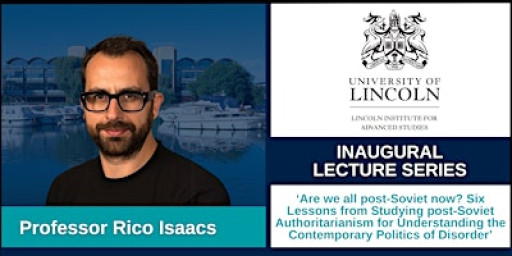
Inaugural Lecture: Professor Rico Isaacs

'Are we all post-Soviet now? Six Lessons from Studying post-Soviet Authoritarianism for Understanding the Contemporary Politics of Disorder’
Short description:
Discussions on the rise of populism around the globe have located its recent resurgence in the global financial crisis of 2008. In this lecture, Professor Rico Isaacs argues differently that the contemporary malaise of political disorder is rooted in the collapse of the Soviet Union in 1991. Professor Isaacs takes six lessons from studying and researching the nature and dynamics of authoritarianism (and failed democratization) in former Soviet republics over the last 20 years, to make sense of the current climate of populist politics across the globe. Drawing on two decades of research on post-Soviet authoritarianism which has included studies of political parties, parliaments, personality cults, cinema and hipsters, Prof. Isaacs will argue that tools and strategies used by post-Soviet authoritarian regimes are being adopted by populists in established liberal democracies today and that if we value democracy, we must acquire tools of resilience to protect it.
Biography:
Rico Isaacs is a Professor of International Politics at the University of Lincoln. His research concerns the relationship between culture and politics and how this appears in authoritarian, nationalist and populist politics with a specific focus on the post-communist space, especially Central Asia. He is the author of Political Opposition in Authoritarianism (Palgrave 2022), Film and Identity in Kazakhstan: Soviet and post-Soviet Culture (Bloomsbury 2018) and Party System Formation in Kazakhstan: Between Formal and Informal Politics (Routledge 2011), as well as authoring several edited volumes, including the Routledge Handbook of Contemporary Central Asia (Routledge 2021) and a Critical Reader in Central Asian Studies (Routledge 2022). He also co-authored an introduction to Politics textbook and has published widely in leading peer-reviewed journals. He has received research funding from Horizon Europe, the British Academy, the Leverhulme Trust and the British Council. He is also currently serving as editor of the leading peer-reviewed journal in Central Asian Studies, Central Asian Survey and holds visiting professorships at Riga Stradinš University in Latvia and the College of Europe in Natolin, Warsaw.
All personal information processed by the University of Lincoln is stored securely and processed in accordance with the UK data protection legislation. For further information please read our Privacy Notice: https://lias.lincoln.ac.uk/privacy-notice/
On occasion, there may also be a photographer or videographer in attendance at events, taking pictures for use within University of Lincoln marketing materials, including the LIAS website (lias.lincoln.ac.uk). Please make the photographer aware if you would not like your image to be used.