
Government & Politics
‘I Miss Mom’: Mental Health Effects of Being Raised by Grandparents

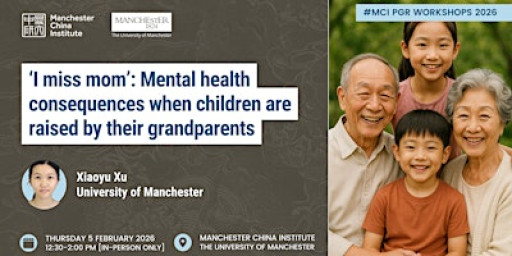
This talk will present a research plan examining skipped-generation households (SGHs), families where grandparents raise grandchildren without the presence of parents, and their implications for adolescent mental health across spatial and temporal dimensions. First, it will outline a spatial analytical framework to map how SGHs are distributed across China using province-level data from the China Family Panel Studies. By applying Moran’s I, LISA clustering, and Geodetector, the study aims to identify regional hotspots and assess how geographic disparities in SGH prevalence relate to variations in adolescent depressive symptoms. Second, the project will outline a longitudinal approach to examining how living in SGHs shapes the development of depressive symptoms over time.
It will further explain potential mechanisms, such as caregiving strain, reduced parental involvement, emotional closeness with grandparents, and socioeconomic constraints. And this study will explore how factors like age, gender, and household socioeconomic status moderate these effects.This project is motivated by the growing prevalence of SGHs in China and the need to understand their uneven regional distribution and long-term mental health consequences for adolescents. Its findings will advance research on family structure and intergenerational care while offering evidence to inform targeted social policies and regional support strategies.
Xiaoyu Xu is a PhD student in Social Statistics at the University of Manchester. Her research focuses on family structure, intergenerational living arrangements, and mental health. Her current work uses longitudinal survey data examine how intergenerational care patterns influence adolescent well-being across different time-period and spatial contexts.
She studied MSc in Social Research Methods and Statistics at the University of Manchester, where she completed training in Statistical Modelling, Longitudinal Data Analysis, Structural Equation and Latent Variable Modelling. Her postgraduate training informs her current research, and her master’s dissertation on skipped-generation households and adolescent mental health provides the empirical and theoretical foundation for her doctoral work.
During her undergraduate studies, she gained experience in quantitative and qualitative research, including social psychology, targeted sampling, and data visualisation. She also conducted field investigations to examine technology-related behavioural patterns, providing a strong foundation for analysing spatial and temporal dynamics in social issues.
MCI’s PGR workshops are lunchtime seminars held in person at the Manchester China Institute. They seek to bring together students, faculty and staff who can best provide feedback as postgraduate researchers develop their ideas. Free lunch will be provided.
The MCI is a listed building and therefore does not have any lifts. Please note that you must use the stairs in order to access the venue and the toilets.
The organisers will be taking photos during this event. If you prefer not to be included in any photos, kindly inform the organisers before the event starts.