
Science & Technology
Focusing innovation in agri-tech standards and regulation

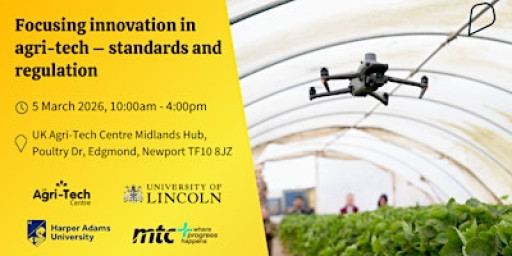
This workshop marks the final of a series of knowledge exchange events hosted by the Agri-Robotics Regulatory Network (ARRNet).
ARRNet, a collaboration between the UK Agri-Tech Centre, Lincoln Institute for Agri-food
Technology, Harper Adams University and the Manufacturing Technology Centre, has been working to overcome the remaining barriers to the widespread adoption of robotics and automation in agriculture.
Following 12 months of grant funding, the project has completed a comprehensive study of the regulatory and standards landscape, testing protocols and facilities, and training regimes that support the development and adoption of robotics in agriculture. Join us to explore how these findings can be used to support agri-robotics companies, innovators, and the wider goals of the Industrial Strategy.
The Lincoln Institute for Agri-Food Technology will present findings from its comprehensive review of global standards, identifying gaps and highlighting generic or translatable standards for agriculture from other sectors.
Building on this work, the UK Agri-Tech Centre will present a roadmap outlining a framework for developing new standards, guidance, and training to support innovation and the sharing of best practices.
Standards define procedures and criteria to ensure consistent and repeatable testing, providing the means to demonstrate compliance with regulations and ensure safe, reliable, and accurate operation. We’ll discuss assessment protocols that enable certification and identify where testing can be conducted.
Safe and reliable deployment requires developers and end users to have the necessary skills to design robust products that can successfully pass compliance testing and be operated by competent users. Harper Adams University will present findings from its review of training needs and available training providers.
We will also explore the importance of regulatory frameworks and technical standards in facilitating innovation, highlighting lessons from recent history, and throughout the day there will be wider discussions on the findings and potential next steps for the industry.
Reasons to attend
AGENDA