
Exhibitions
Exhibition Opening - John Hubbard: Landscapes of Distance

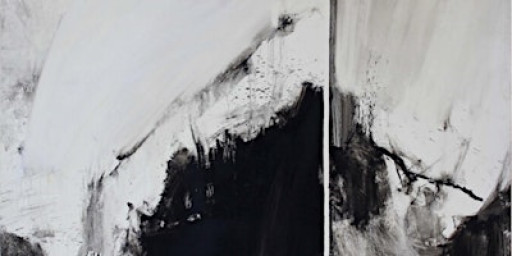
John Hubbard: Landscapes of Distance traces shared spirits of withdrawal into nature and the conscious making of place across Eastern and Western aesthetics, through the life and work of the American-born painter John Hubbard (1931– 2017).
The exhibition centres on a group of large-scale monochrome paintings produced in the early 1960s, shortly after Hubbard’s arrival in Dorset. Unexhibited during the artist’s lifetime, these works are presented in Cambridge as a rare opportunity to reconsider an artist whose trans-cultural imagination unfolds through ink-like gesture, atmospheric rhythm, and a sustained, almost devotional, attentiveness to the natural world.
Hubbard’s personal and artistic journeys, from the United States to Japan, then to post-war European artistic centres, and ultimately to the rural quietude of Dorset, offer a compelling lens for understanding how an artist works through two entwined acts: leaving the centre, and making a life and worldview through nature.
Though trained under Hans Hofmann and shaped by Abstract Expressionism, Hubbard rejected the competitiveness of the New York art world, turning instead toward a mode of abstract landscape that resonates with Chinese Daoist ideals of perpetual motion and oneness with nature, as well as European traditions of solitude and pastoral reflection.
The exhibition proposes Hubbard as a cross-cultural figure of the artist-wanderer: one who turns away from the accelerations of modernity to cultivate a contemplative relationship with land, time, and interiority. In foregrounding these deliberate modes of distance, the exhibition invites contemporary audiences to reconsider alternative ways of seeing, dwelling, and attending to the world.